
A Journey Through Decades of Energy Transformation
At the end of 2025, we started a journey through the decades of India’s energy transformation. Parts One and Two examined the “Kitchen Revolution” and the challenges of “Heating in a Warming Climate.”
Today, India stands transformed. Over 329 million households cook with LPG. Railways have electrified over 99% of their network. This is the story of India’s fuel evolution—told not from spreadsheets and policy documents alone, but from memory, from experience, from the kitchen to the trains—to the roads of tomorrow.
Part Three: The Railways Revolution
The Steam Era (1853–1995)
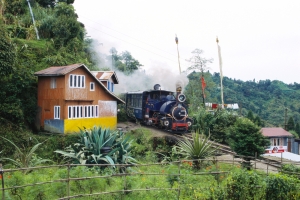
Indian Railways began with steam and remained wedded to it longer than almost any major rail network in the world. When the first train ran from Bombay to Thane on April 16, 1853—a journey of 34 kilometers powered by three steam locomotives named Sindh, Sultan, and Sahib—it inaugurated not just a transportation system but a transformation of Indian society.
Steam locomotives burned coal, and Indian Railways became one of the largest coal consumers in the country. The railway network expanded relentlessly: by independence in 1947, India had over 50,000 kilometers of track, most served by steam. The great locomotive workshops at Chittaranjan produced thousands of steam engines, and railway colonies across the country housed the workers who kept the iron horses running.
The romance of steam is undeniable—the whistle echoing across plains, the rhythmic chuffing, the drama of massive machines conquering distance. But steam was also inefficient, labor-intensive, and polluting. A steam locomotive typically converted only 6-8% of coal’s energy into motion; the rest escaped as heat and smoke.
India held onto steam longer than most, with the last broad-gauge steam service running until 1995. The final steam locomotives were retired from regular service in the early 2000s, though heritage trains still operate for tourists. When the last fires were dropped from those fireboxes, an era ended—but a more efficient one had long since begun.
The Diesel Transition (1957–Present)
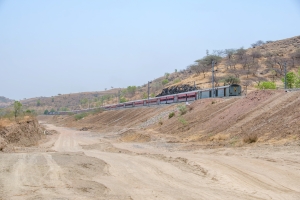
The first diesel locomotive arrived in India in 1957, and the advantages were immediate: higher efficiency (25-30% thermal efficiency versus steam’s 6-8%), lower maintenance requirements, faster acceleration, and the ability to operate in areas without coal or water supplies.
The Diesel Locomotive Works at Varanasi, established in 1961, became the manufacturing heart of India’s diesel transition. By the 1980s, diesel had displaced steam on most main lines, and by the 1990s, steam survived only on branch lines and in railway museums.
At diesel’s peak, Indian Railways operated over 5,500 diesel locomotives, consuming approximately 2.8 billion liters of diesel fuel annually. The fuel bill represented one of the railway’s largest operating costs, and every spike in global oil prices hit the railway budget directly.
Electrification: The Silent Revolution (1925–2030)
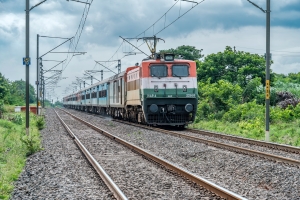
Railway electrification in India began modestly in 1925, when the first electric train ran between Bombay’s Victoria Terminus and Kurla. For decades, electrification proceeded slowly, limited to suburban networks around major cities. As late as 2014, only about 33% of India’s rail network was electrified.
Then came an acceleration unlike anything in railway history. The Indian government set an ambitious target: 100% electrification of broad-gauge routes by 2023-24. While the deadline has slipped slightly, the progress has been extraordinary:
- 2014: Approximately 21,000 route-kilometers electrified
- 2025: Over 69,000 route-kilometers electrified; over 99% of broad-gauge network
- Target: 100% broad-gauge electrification by 2025-26
Indian Railways now operates over 13,294 electric locomotives and is rapidly adding more. Electric trains are faster, cleaner, cheaper to operate, and align with India’s renewable energy ambitions. When an electric train draws power from a grid increasingly fed by solar and wind, every journey becomes cleaner.
The railway has set a target of becoming a “net-zero carbon emitter” by 2030—an astonishing ambition for one of the world’s largest rail networks. It’s pursuing this through electrification, solar installations on railway land, energy-efficient coaches, and green building certifications for stations.
Looking Forward: The Unfinished Revolution
India’s energy transformation is still in progress, and the challenges are immense. India’s electricity grid still draws over 70% of its power from coal, which means electric railways or an induction cooktop are only as clean as the grid that powers them. Scaling renewable energy to meet exploding demand—from air conditioning, industry, and cooking electrification—requires investments measured in hundreds of billions of dollars.
But the path is clear, and India has demonstrated its capacity for transformation at scale. In just three decades, they moved 97% of their rural population off biomass cooking and have electrified 99% of the world’s fourth-largest railway network.
In the coming weeks we will continue our exploration of India’s energy transformation. The final post in this series will examine changes in India’s automotive sector and how these changes impact today’s energy markets.
India’s Fuel Revolution: Part Three
By Kevin Josh