
A Journey Through Decades of Energy Transformation
As we prepare to close 2025, I find myself doing what many of us do this time of year—Pausing – Reflecting – Wondering.
This year, one thing has occupied my mind more than most: “FUEL” The invisible force that powers nearly everything we do—cooking our meals, warming our homes, moving us from place to place. We rarely think about it, yet we are all in sync with it, dependent on it, shaped by it.
And when I think of fuel, I think of India.
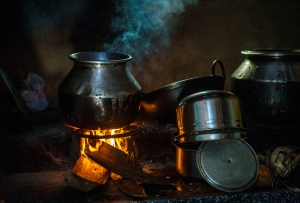
An Indian village at dawn smells of wood smoke rising from a hundred kitchens, settling into clothes and memory alike. It’s the smell of home for millions. It’s also the smell of a crisis that has shaped policy, sparked innovation, and driven one of the largest clean energy transitions on earth.
I grew up in that world—where firewood was gathered, kerosene was rationed, and the arrival of an LPG cylinder was an event worth celebrating. Where steam trains thundered through stations, leaving trails of coal dust and wonder. Where “fuel” wasn’t an abstraction but a daily negotiation between tradition, affordability, and survival.
India’s Transformed Energy Market
Today, India stands transformed. Over 329 million households cook with LPG. Railways have electrified over 99% of their network. Over ~7 million electric vehicles move through streets that once knew only bullock carts and diesel fumes.
For those of us in the energy sector, India isn’t just a market—it’s a masterclass. In scale, complexity, and what’s possible when policy, technology, and human aspirations align.
This is the story of India’s fuel evolution—told not from spreadsheets and policy documents alone, but from memory, from experience, from the kitchen to the trains—to the roads of tomorrow.
Part One: The Kitchen Revolution
Firewood & Biomass: The Original Fuel (Pre-1960s–Present)
For thousands of years, India’s kitchens ran on what the land provided. Firewood. Crop residues. Dried cow dung shaped into patties and stacked against village walls like currency. In 1991, the Census of India found that 97% of rural households depended on biomass for cooking. By 2020-21, that figure had dropped to 47%—still substantial, but a dramatic shift in just three decades.
The health toll of traditional biomass cooking remains staggering. The World Health Organization estimates that household air pollution from solid fuel combustion causes over 4 million premature deaths globally each year, with India bearing a disproportionate share. Women and children, who spend the most time near cooking fires, suffer most from respiratory diseases, eye ailments, and burns.
Yet biomass persists—not from ignorance, but from economics and accessibility. For millions of families in remote areas, gathering firewood costs nothing but time. LPG cylinders cost money, require delivery infrastructure, and depend on supply chains that don’t always reach the last mile.
Biogas (Gobar Gas): India’s Indigenous Innovation (1850s–Present)
India’s relationship with biogas spans over 160 years, making it one of the world’s earliest adopters of anaerobic digestion technology. The first anaerobic digestion plant in India was built in Bombay in 1857-1859—a full-scale facility at a leper colony that used biogas generated from the treatment facility to light streets. This predates even the famous 1895 Exeter, England installation that powered streetlamps.
The modern gobar gas movement began taking shape in the 1960s. The Gobar Gas Research Station established at Ajitmal, Uttar Pradesh in 1962 marked the beginning of systematic research into adapting biogas technology for rural Indian conditions.
Government programs followed: the National Project on Biogas Development (NPBD) launched in 1981, promoting family-sized digesters that could convert cattle dung into cooking gas and organic fertilizer. The Deenbandhu (“Friend of the Poor”) model, introduced in 1984, offered a lower-cost fixed-dome alternative. By 2023, India had installed over 5.1 million family-type biogas plants with a combined capacity exceeding 4.43 million cubic meters per day.
LPG: The Clean Cooking Revolution (1955–Present)
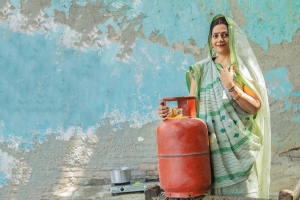
The story of LPG in India is a story of patient infrastructure-building followed by explosive growth. Indian Oil Corporation commissioned its first LPG bottling plant in 1955, but for decades, LPG remained an urban luxury—expensive, scarce, and dependent on distribution networks that barely extended beyond major cities.
The transformation began with liberalization in the 1990s, accelerated through the 2000s, and reached escape velocity with the Pradhan Mantri Ujjwala Yojana (PMUY), launched in 2016. PMUY specifically targeted women from households below the poverty line, providing free LPG connections to families who had never cooked with anything but biomass.
The numbers tell a remarkable story:
- 2016: PMUY launches with a target of 50 million connections
- 2019: Target raised to 80 million connections
- March 2025: 103.3 million PMUY beneficiaries; over 330 million total active LPG consumers nationwide
India now operates the world’s largest LPG distribution network, with over 24,000 distributors reaching every district. Average per capita LPG consumption has risen from about 8 kg in 2014-15 to over 12 kg today. The Oil Marketing Companies deliver approximately 2.5 billion cylinders annually.
Yet the LPG story isn’t complete. Refill rates among PMUY beneficiaries remain lower than among traditional consumers, suggesting that while connections have expanded, sustained use faces economic barriers. The average PMUY household consumes about ~4.43 cylinders per year, compared to 7-8 for non-PMUY households. Affordability remains the frontier.
Looking Forward: The Unfinished Revolution
India’s energy transformation is far from complete. The final mile remains the hardest: ensuring that every household can afford to cook with clean fuel regularly, not just occasionally.
But the trajectory is clear. A country that moved 97% of its rural population off biomass cooking in just three decades, that country has demonstrated its capacity for transformation at scale.
For energy professionals, investors, and policymakers watching India, the lessons are profound. Change happens slowly, then suddenly. Infrastructure investments compound over decades. Government policy, when sustained and well-designed, can reshape the choices available to hundreds of millions of people.
Our exploration of India’s energy transformation will continue. Over the coming weeks, future posts will examine the changes that have occurred in India’s heating and transportation sectors, and how these changes impact today’s energy markets.
India’s Fuel Revolution: Part One
By Kevin Josh