

Interest Rates and the Energy Market
The past three months, our current events’ posts have been focused on the war between the United States and Iran. These posts have discussed the ramifications of all the conflict currently taking place in the Middle East.
While there is still not a clearly defined truce, on Monday, Iran and Israel appear to have paused their attacks following an escalation of conflict in Lebanon. Despite the continuing uncertainty about these events, we are going to step away from discussing the war for this month and talk about something different.
And what else is there to talk about? We are so glad you asked.
The topic we would like to explore today is – Interest rates!
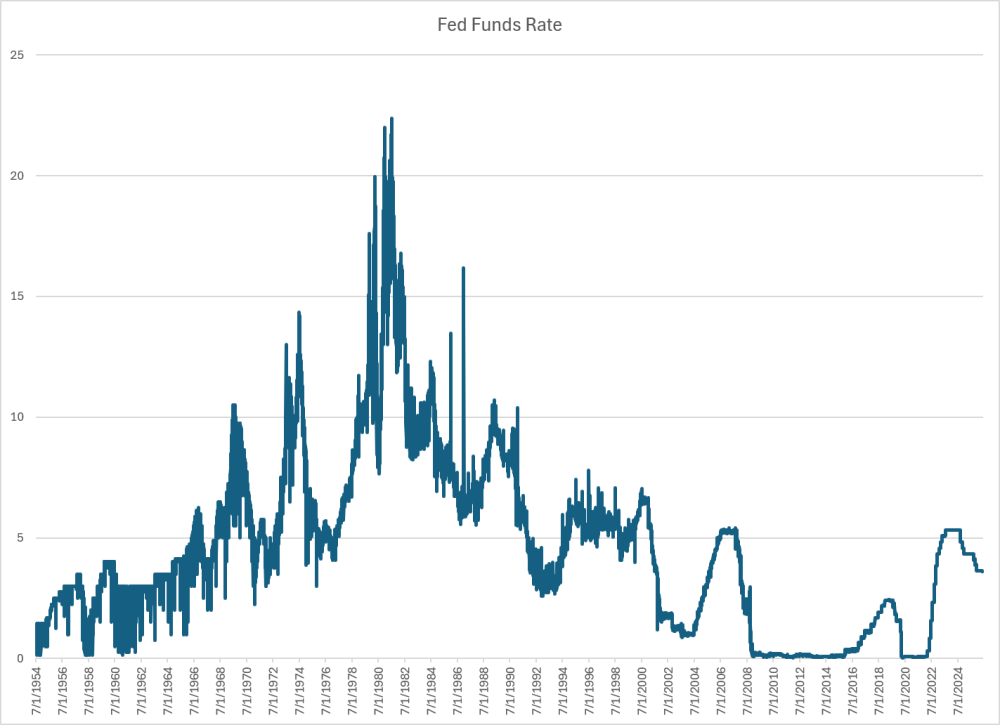
Below is a snapshot of the Federal Funds rate from 1954 through the present day.
A Little History
Up until the middle of the 1960s interest rates were relatively tame. However, 1965 ushered in a multi-decade surge in the Federal Funds (Fed Fund) rate that didn’t abate until the infamous Paul Volker decisions of the early 1980s. Following those decisions, the Fed Fund rates did not return to that 1955-1964 rate range until 2001.
Over the past 70+ years, the Fed Fund rate has averaged 4.67%, reaching a peak of 22.36% in July 1981 and dropping to a low of 0.04% in 2020. What else is worth noting is that rates were at record lows from 2008 to early 2016, while the years 2008-2022 show the second lowest rates of this entire historical period.
Why this is important
So why does this trip down the Fed Funds rate memory lane matter?
More importantly, why does it matter NOW?
To answer the first question, we wanted to look at historic interest rates from the 2001 drop (October 2001) through September 2022. This period saw average Fed Fund rates of 1.317%. If you look at the graph shown above, there are no other time periods of that tenure with such low rates.
Another thing that was happening during the two-decade period of low rates was the abundant growth of U.S. energy products. Pull up any production curve for oil, natural gas, or propane and you will see steady upward growth. For propane in particular, the production has been on an annual rise from 2010 forward (EIA data).
Did low interest rates cause this growth? We won’t say there is a definite relationship, but it certainly helped to have lower capital costs to fund a major energy growth cycle.
Moving to the second question: Why does understanding the history of interest rates matter NOW? We have to recognize that rates are still below the average of the last 70+years. However, rates are nowhere near the low of the 20+year cycle that helped fuel incredible growth in U.S. energy production.

Conclusion
Most attention right now is focused on the desire for resolving conflict in the Middle East and allowing energy products to freely flow through the Strait of Hormuz. But there is another factor that must be acknowledged – the cost to rebuild the damage done by war and to revive energy production.
During other crises of recent memory, such as the dot-com crash, the 2007-2008 market fall, and COVID, interest rates were virtually zero. Current Fed Fund rates stand at 3.62%, a historically competitive value but nowhere near zero.
These current rates along with the historical picture give us a bit of pause regarding a massive surge in energy production if, and when, there is a resolution with Iran. If rates remain at current levels or even edge closer to 4.5%, we could see energy prices remaining more bullish for a longer period solely based on the fact that financing costs are higher than the previous 20+ year period.
Interest rates may not always take center stage in the energy markets, but we should still be aware of their historical role and the impact these rates could have on the future.
Current Events – June 2026
By JD Buss