
Shift in Global Oil Flow
On Monday afternoon, February 2, 2026, news came out that India and the United States have reached a trade agreement. While nothing has been released on the Federal Registry, the Truth Social post from President Trump stated, “…we agreed to a Trade Deal between the United States and India, whereby the United States will charge a reduced Reciprocal Tariff, lowering it from 25% to 18%.”
Negotiating for – oil and an end to war on Ukraine
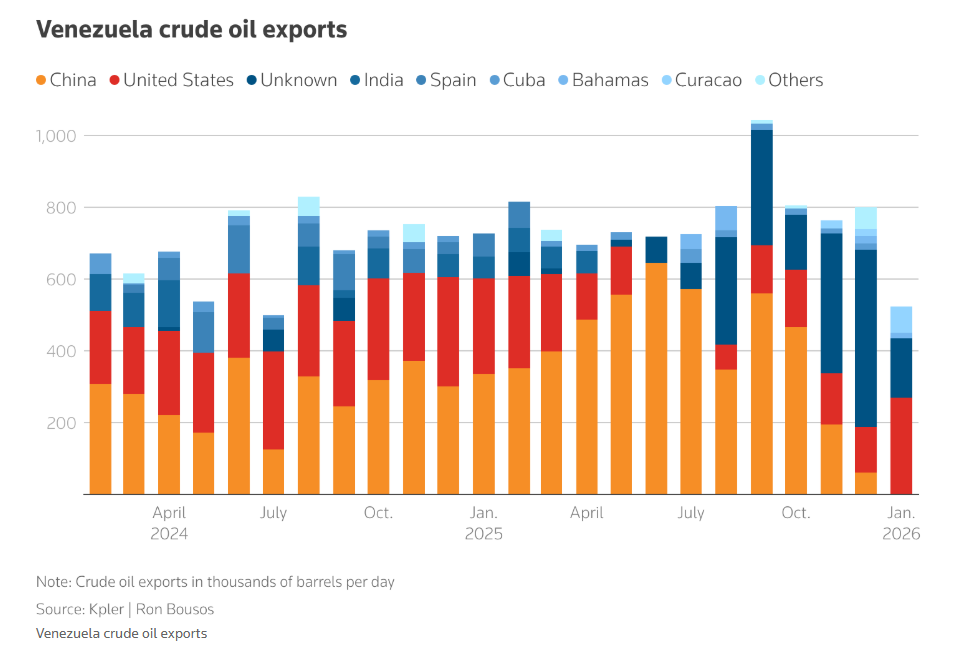
Oil may be at the heart of this negotiation, along with a push to end the Russian war on Ukraine. The United States’ capture of Venezuelan oil has now produced a major bargaining chip that can be used with other nations. The Kpler graph below highlights how far Venezuelan exports have fallen recently.
Two Questions
While there is clearly capacity available, two major questions are still unanswered:
- Will there be enough future production?
- Will the price fit?
On the first question, the U.S. still hasn’t received major investments from oil firms looking to revitalize Venezuelan oil production. Shifting to the second question, one of the reasons that Venezuelan oil moved in the open market was due to strong discounts. A recent Reuters article highlighted the fact that Asian buyers recently balked at $5/bbl discount to accept Venezuelan oil.

Possible Outcomes
Regardless of answers to those questions, it appears that the most recent “addition” to U.S. oil production (Venezuela) could be an enticement for a trade deal. However, it could also be a crafty move by India to push for even better prices.
The same Reuters article mentioned above stated that Russian oil was being priced at $20/bbl discount recently. Indian refiners still purchase roughly 20% of their oil supply from Russia. Bringing in discounted Venezuelan crude could reduce a modest amount of Russian oil or simply be a negotiation tool to press for higher discounts. In either situation – a lower price or lower volume – Russia likely receives less overall revenue. This may be the push that the U.S. was looking for in the long run.
Conclusion
We are not expecting a massive flow of Venezuelan oil to start migrating to India. We are however, expecting a gradual shift in product flow that will start to reshape the global landscape of oil. Even with conflict and tariffs, oil remains a global commodity and will continue to flow from one nation to another.
Because oil is a global commodity, and any shifts in the flow of product between countries impacts the overall energy industry, Westlark Advisors will continue to closely watch this situation as it develops.
Curent Events – February 2026
By JD Buss